What is MCP (Model Context Protocol)? The Complete 2026 Guide
MCP (Model Context Protocol) is the open standard that lets AI agents securely connect to real systems. Full guide, examples, and how to deploy MCPs in 1 click with ABLE.
Respuesta rápida
Model Context Protocol (MCP) is an open standard introduced by Anthropic in late 2024 that defines how AI agents discover, authenticate against and call external tools and data sources. Instead of writing custom integrations per LLM, developers expose capabilities once as an MCP server and any compatible agent can use them. ABLE ships a curated MCP Marketplace with 1-click deploy for the most-used systems (Drive, Calendar, HubSpot, Salesforce, Slack, Stripe, Shopify, Twilio and more).
1. The problem MCP solves
Before MCP, every AI agent that needed to read your calendar, query your CRM or send a WhatsApp message required a custom integration per model, per vendor. OpenAI plugins didn't work with Claude. Claude tool-use didn't work with Gemini. Every framework reinvented the same connectors.
The result: developers spent more time on glue code than on actual agent logic, and enterprise IT teams had no consistent way to audit what agents were doing.
2. What MCP actually is
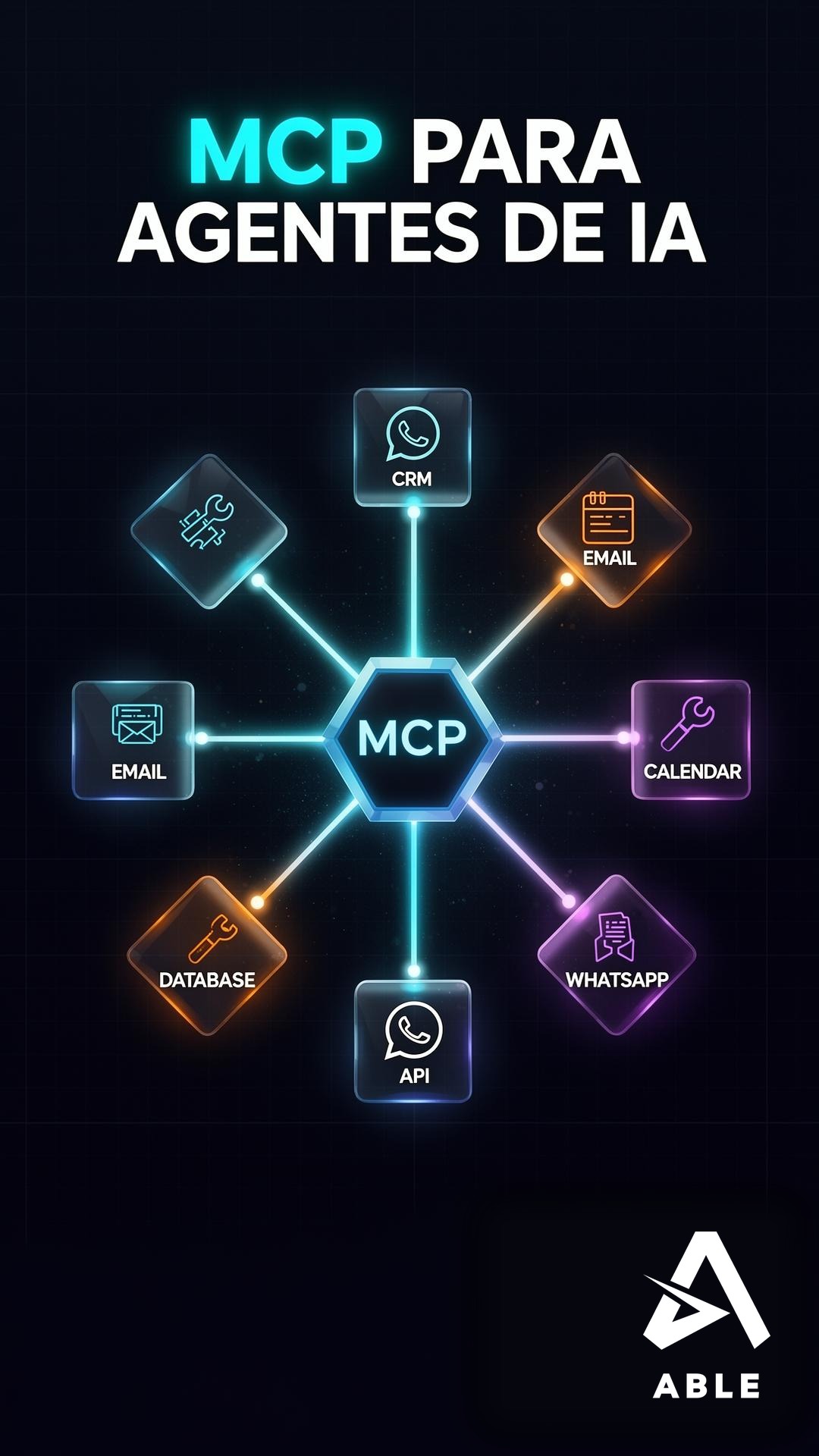
The Model Context Protocol is an open specification that defines a contract between two parties:
- MCP Server — exposes a set of capabilities (tools, resources, prompts) over a standardized API.
- MCP Client — an agent runtime that discovers servers, lists their capabilities, requests permissions and invokes them.
The transport can be local (stdio) or remote (HTTP/SSE). The schema is JSON-RPC 2.0. The whole spec lives at modelcontextprotocol.io.
3. Why it became "USB-C for AI"
The analogy is exact: one connector, many devices. Build an MCP server for HubSpot once and every MCP-compatible agent — Claude Desktop, OpenAI Agents SDK, ABLE, custom apps — can use it without modification.
That's why adoption exploded in months. Today there are public MCP servers for Drive, Sheets, Calendar, Slack, GitHub, Linear, Notion, Stripe, Shopify, Salesforce, HubSpot, Postgres, Brave Search and hundreds more.
4. The core primitives
Tools
Functions the agent can call. Example: create_calendar_event, search_contacts, send_whatsapp_template.
Resources
Read-only data the agent can fetch. Example: a Drive file, a database row, a knowledge base article.
Prompts
Reusable prompt templates the server suggests to clients. Useful for vendor-specific best practices.
5. How an MCP call actually flows
- User talks to an agent on WhatsApp: "book me a 30-min slot with the new lead Tuesday."
- Agent (MCP client) lists tools from the connected Calendar MCP server.
- LLM decides to call
list_availability, thencreate_event. - MCP client invokes those JSON-RPC methods.
- MCP server executes against the real Google Calendar API, returns the event ID.
- Agent confirms in natural language to the user.
No custom code per LLM. No re-implementation per agent framework.
6. MCP vs alternatives
| Approach | Portability | Standardized | Multi-model |
|---|---|---|---|
| OpenAI Plugins | OpenAI only | No | No |
| LangChain Tools | LangChain apps | De facto | Yes (via LC) |
| Vendor SDKs (HubSpot/Salesforce) | Per-vendor | No | No |
| MCP | Any client | Yes (open spec) | Yes |
7. Where MCP fits in agentic architectures
A modern agentic stack has four layers:
- Model layer — LLMs (Claude, GPT, Gemini, open-source).
- Agent runtime — orchestrator that decides which model to use and when.
- Capability layer (MCP) — tools, resources, memory.
- Channel layer — WhatsApp, voice, web, email.
MCP standardizes layer 3 so layers 1 and 2 can evolve independently from layer 4.
8. The ABLE MCP Marketplace
Building and hosting MCP servers in production is non-trivial: auth, secrets, rate limits, observability, versioning. The ABLE MCP Marketplace ships dozens of curated MCPs with:
- One-click deploy from the catalog.
- OAuth and secret management out of the box.
- Per-agent scoping and audit logs.
- Pay-as-you-go pricing per execution.
If you're a developer, you can also publish your own MCP and monetize each install.
9. Real-world use cases
- Sales — WhatsApp lead qualifier with MCPs for HubSpot, Calendar, Slack and Stripe.
- Hospitality — concierge agent that reads availability from Mews/Opera and triggers upsells.
- Real estate — virtual staging + CRM updates via Tokko/idealista MCP.
- Support — voice agent escalating tickets to Zendesk via MCP.
- Back office — accounting agent that reads Sheets, posts to Odoo and emails reports through SendGrid.
10. Security and governance
Enterprise MCP deployments share three rules:
- Least privilege — scope tokens to the narrowest folder, account or pipeline.
- Audit everything — every tool call is logged with user, agent, tool, args and result.
- Human-in-the-loop on writes — require confirmation for destructive actions (delete, refund, send).
ABLE enforces all three by default in marketplace MCPs.
11. What's next
Expect MCP to become the default integration layer for agents — much like REST became for the web. The interesting battles will move up the stack: orchestration, memory, evaluation, governance and channel reach.
Ready to ship MCP-powered agents?
Browse the ABLE MCP Marketplace, deploy in one click and connect to any agent — no engineering required.
Open the MCP Marketplace →Want the Spanish edition? Read ¿Qué es MCP? Guía completa 2026.
Preguntas frecuentes
What does MCP stand for?
Model Context Protocol. It's an open standard for connecting AI agents (LLM-powered apps) to external data and tools.
Who created MCP?
Anthropic introduced MCP in November 2024. It has since been adopted by OpenAI, Google and the broader agent ecosystem.
Is MCP only for Claude?
No. MCP is model-agnostic. Any agent runtime can act as an MCP client — Claude, GPT, Gemini, open-source LLMs, ABLE.
What's the difference between MCP and a plugin?
Plugins are vendor-specific (OpenAI plugins, Copilot plugins). MCP is an open protocol — one MCP server works across every compatible agent platform.
Is MCP secure?
Yes if implemented properly: OAuth/token auth, scoped permissions, audit logs. ABLE's marketplace MCPs follow these patterns by default.
How do I use MCP without writing code?
Deploy a server from the ABLE MCP Marketplace in one click and connect it to any agent — no engineering required.
Fuentes
- Introducing the Model Context Protocol · Anthropic
- MCP Specification · modelcontextprotocol.io
- OpenAI Agents + MCP · OpenAI












%20--%3e%3csvg%20version='1.1'%20id='layer'%20xmlns='http://www.w3.org/2000/svg'%20xmlns:xlink='http://www.w3.org/1999/xlink'%20x='0px'%20y='0px'%20viewBox='0%200%20652%20652'%20style='enable-background:new%200%200%20652%20652;'%20xml:space='preserve'%3e%3cstyle%20type='text/css'%3e%20.st0{fill:%23009239;}%20%3c/style%3e%3cpath%20d='M214.8,354.2c0,6.3,4.2,11.1,11.3,11.1c7.2,0,11.3-4.8,11.3-11.1c0-6.1-4.2-11.3-11.3-11.3C219,342.9,214.8,348,214.8,354.2%20M254.6,374.5c0,21.1-10.5,29.7-28.8,29.7c-11.4,0-26.8-5.9-28.3-19h19.8c0.5,1.7,1.7,3,3.3,3.8c1.6,0.8,3.4,1.2,5,1.2%20c9.5,0,11.3-6.2,11.3-14.3v-2.3c-4.6,4.6-9.2,6.8-15.8,6.8c-14.5,0-24.5-11-24.5-25.4c0-14.5,10.3-27,25.5-27%20c5.8,0,11.1,1.9,14.6,6.9h0.2v-5.2h17.7V374.5z%20M299.4,347.3c-0.9-4.7-5.2-7.8-10-7.8c-5.1,0-9.4,2.7-10.5,7.8H299.4z%20M315.7,357.4%20h-37.1c0,7.2,3.8,11.1,11.1,11.1c3.8,0,6.5-1.3,8.4-4.6h17c-2.8,11.7-14,17.1-25.3,17.1c-16.5,0-28.8-9.3-28.8-26.5%20c0-16.6,11.3-26.6,27.5-26.6c17.3,0,27.2,10.7,27.2,27.6V357.4z%20M341.3,354.5c0,6.3,4.2,11.1,11.3,11.1c7.2,0,11.3-4.8,11.3-11.1%20c0-6.1-4.2-11.2-11.3-11.2C345.5,343.3,341.3,348.4,341.3,354.5%20M382.6,354.5c0,16.9-14,26.5-30,26.5c-15.9,0-30-9.5-30-26.5%20c0-17,14-26.6,30-26.6C368.7,328,382.6,337.6,382.6,354.5%20M427.9,345.8c-2.6-1.9-5.7-3.5-9.1-3.5c-6.8,0-12.1,5.2-12.1,12.1%20c0,7.2,5.1,12.2,12.4,12.2c3.1,0,6.5-1.3,8.8-3.4v14.9c-3.9,1.9-8.1,2.8-12.4,2.8c-14.7,0-27-11-27-26c0-16,12.2-27,27.8-27%20c4.1,0,8.1,1,11.6,2.9V345.8z%20M431.8,329.6h20.4l13.3,25.5l13-25.5h20.1l-39.8,74.6h-19.8l17-31.6L431.8,329.6z%20M533.8,345.8%20c-2.6-1.9-5.7-3.5-9.1-3.5c-6.8,0-12.1,5.2-12.1,12.1c0,7.2,5.1,12.2,12.4,12.2c3.1,0,6.5-1.3,8.8-3.4v14.9%20c-3.9,1.9-8.1,2.8-12.4,2.8c-14.7,0-27-11-27-26c0-16,12.2-27,27.8-27c4.1,0,8.1,1,11.6,2.9V345.8z%20M560.2,379.4h-17.7v-79.7h17.7%20V379.4z%20M604.4,347.3c-0.9-4.7-5.2-7.8-10-7.8c-5.1,0-9.4,2.7-10.5,7.8H604.4z%20M620.8,357.4h-37.1c0,7.2,3.8,11.1,11.1,11.1%20c3.8,0,6.5-1.3,8.4-4.6h17c-2.8,11.7-14,17.1-25.3,17.1c-16.5,0-28.8-9.3-28.8-26.5c0-16.6,11.3-26.6,27.5-26.6%20c17.3,0,27.2,10.7,27.2,27.6V357.4z'/%3e%3cpath%20class='st0'%20d='M20.8,343.6c-0.4,6.8,3.7,12.4,11.5,12.9c7.8,0.5,12.6-4.5,13.1-11.3c0.4-6.6-3.7-12.5-11.5-13%20C26.1,331.7,21.3,337,20.8,343.6%20M172.2,287.7c-0.9,13.3,7.3,24.1,22.4,25c15.1,1,24.6-8.7,25.4-22c0.8-12.9-7.3-24.3-22.4-25.2%20C182.5,264.6,173.1,274.9,172.2,287.7%20M106.3,255.6c-0.7,11,6,19.9,18.5,20.7c12.5,0.8,20.3-7.2,21.1-18.2%20c0.7-10.7-6-20.1-18.5-20.9C114.9,236.4,107,244.9,106.3,255.6%20M43.8,283.5c-0.6,8.6,4.7,15.6,14.5,16.3c9.8,0.6,15.9-5.6,16.5-14.3%20c0.5-8.4-4.7-15.7-14.5-16.4C50.5,268.5,44.3,275.1,43.8,283.5'/%3e%3c/svg%3e)